
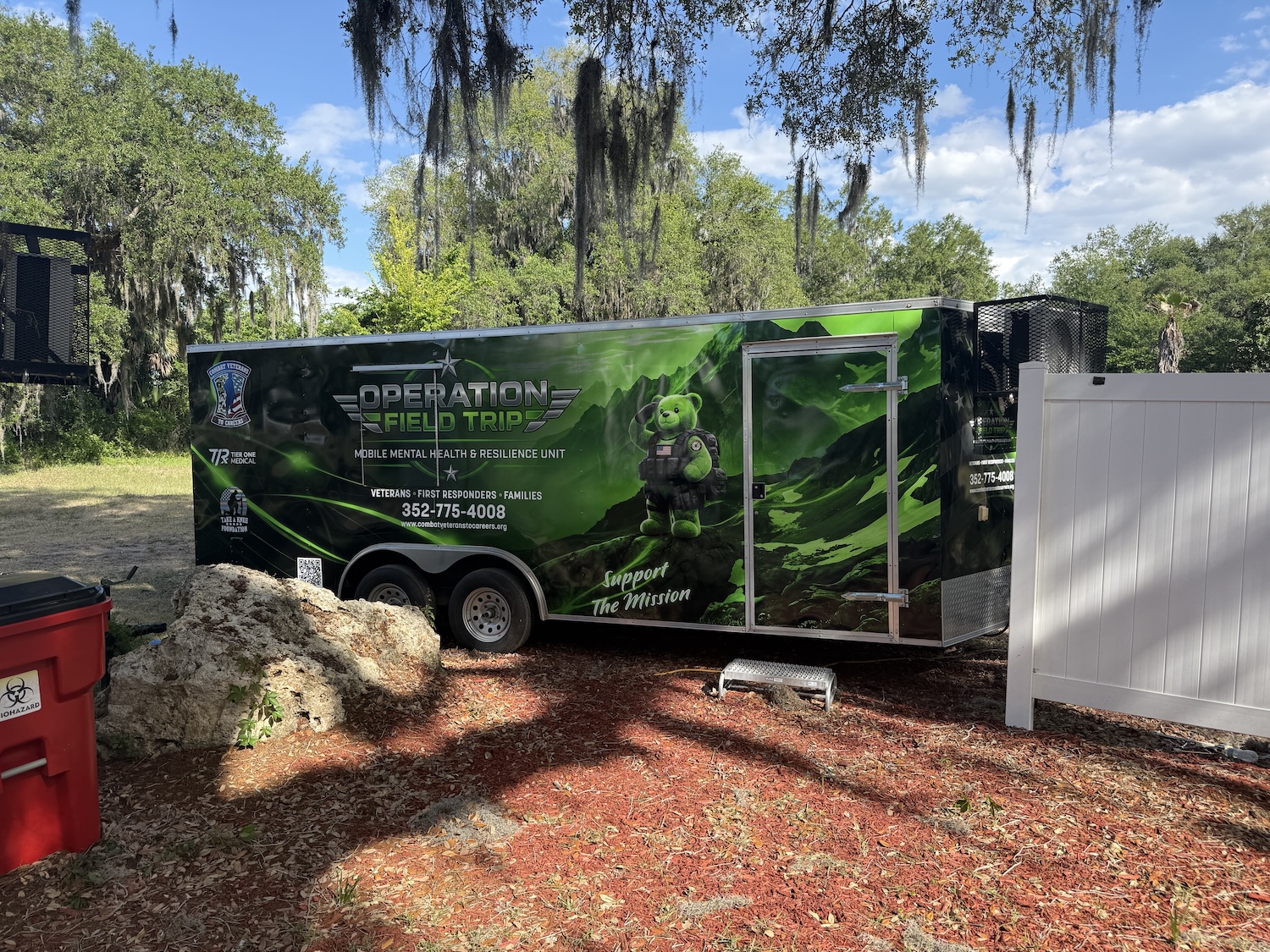
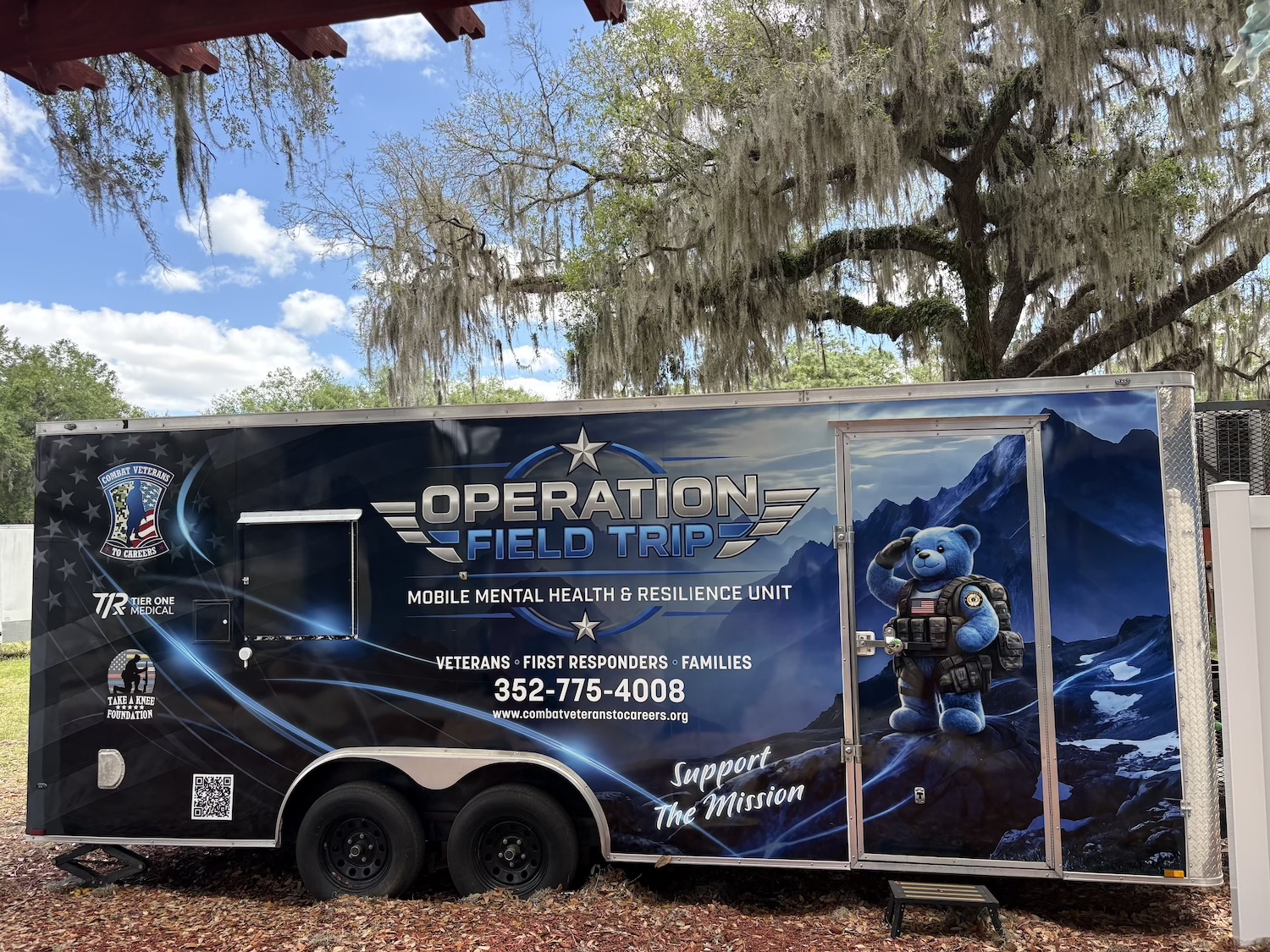
When a wrapped trailer pulls into a VFW lot or a sheriff's department in central Florida, it isn't a recruiting booth and it isn't a roadshow. It's a clinic. Inside, a team of special operations veterans and first-responder therapists is preparing to deliver a treatment protocol that, according to the man who helped develop it, is now the official ketamine protocol at Walter Reed Bethesda. Every veteran, first responder, active-duty service member, or immediate family member who shows up with the right paperwork is treated for free.
This is Operation Field Trip, the flagship program of the Vero Beach-based Take a Knee Foundation. It is a mission moving faster than its founders ever imagined, fueled by an urgent, unmet need for healing.
A Mission Without a Bill
Founded only eighteen months ago, the Take a Knee Foundation was born from a singular goal: "providing care without the financial barriers," explains executive Mandy Espinal. While modest in words, the mission is a radical defiance of market reality. Ketamine-assisted therapy is a premier tool for treating PTSD, yet with sessions often exceeding $800, it remains financially out of reach for many, and insurance coverage is virtually non-existent.
Take a Knee's full treatment package, which includes IV ketamine, talk therapy, and, where needed, hormone management, costs $6,500 per patient to deliver. Patients pay nothing. The Foundation absorbs the cost in partnership with the logistical nonprofit Combat Veterans to Careers (founded by retired Army Ranger David Booth) and Tier One Medical (the contracted medical practice run by Major Kristopher Hasenauer of the 20th Special Forces Group).
"Every $600,000 we raise, we get through a hundred patients," says Hasenauer. The team initially estimated it would take two years to reach their first hundred patients; they achieved it in just four months.
When they started, they figured a hundred patients might take two years. They got there in four months.
Forged in the Field, Adopted by Walter Reed
Operation Field Trip’s protocol has an unusual, organic origin. It was "developed informally by four Green Berets seeking help for themselves and those around them," says Hasenauer. Today, that same regimen has been refined and adopted as the official protocol at Walter Reed Bethesda under the guidance of Dr. Erin Wolfgang, head of psychiatry and a fellow in psychedelic pharmacology at Princeton.
The clinical team shares this operational DNA, comprising pharmacists, directors, and research biochemists who are all special operations veterans. They are joined by therapists with deep roots in the first-responder community, including a former head of behavioral health for the DC Metro Police and a retired sheriff's deputy.
Their philosophy is grounded in science, not spectacle. Ketamine was selected because it is safe, legal, and highly effective when paired with follow-up care. Hasenauer estimates that six weeks of this combined therapy accelerates neuroplastic change to the equivalent of three years of traditional talk therapy alone.
 Bringing the Clinic to the Community
Operation Field Trip’s mobile model is its greatest innovation. Using treatment trailers towed by F-250s, the team sets up at VFWs and departments for twelve-week rotations. They meet patients where they live, providing exams, interviews, and intensive weekend treatments for those traveling from across the country.
"We're a mobile medical treatment unit," Hasenauer said. "We're here to help you with this particular thing. If you are interested, come get your exam, do your interview, fill out your paperwork, and we will help you."
A Vietnam Veteran, a Nightmare, and Fifty-Eight Years
Among those helped was a Vietnam veteran in his late seventies. He arrived skeptical and weary, haunted by the same nightmare every single night since 1967. After his first treatment, he called the team the following morning: the nightmare was gone. Today, he is a vocal champion of the program, bringing other veterans into the fold.
The clinic walls are a mosaic of similar gratitude—Christmas cards and notes from spouses and children. "I got my husband back. I got my dad back. I got my family back."
What The Kash Foundation's Grant Made Possible
A recent grant from The Kash Foundation provided the critical bridge for out-of-state veterans. "We were able to provide that service to people who normally wouldn't have even had that access," says Espinal. "That was life-changing." By removing the barrier of travel, the Foundation's impact now mirrors the national scale of the veteran and first-responder crisis.
The Personal Stakes of Recovery
Hasenauer’s dedication is deeply personal. "I had my own struggles with suicide and alcoholism," he admits. "I was a tactical medical guy... and I was still confused. I know why all the patients are confused." He does the work so that no one else has to reach the depths he did. "I wouldn't wish that on my worst enemy."
For Espinal, the exhaustion of the weekend clinics is eclipsed by the transformation she witnesses. "I've watched it monumentally change people's lives," she says. "We leave those weekends more recharged than we ever are."
This healing often creates a cycle of service; almost every participant asks how they can volunteer or help others find the same path. However, a lingering obstacle remains: self-comparison. Espinal frequently meets individuals who turn down treatment because they feel someone else has it "worse." Hasenauer is blunt in response: trauma is relative, and healing requires showing up as an active participant in one's own recovery.
The Horizon: Scaling the Mission
Operating with a lean team of eight, the goal is to scale to eighty, open a permanent facility with dorms, and deploy mobile teams across every state—starting with Texas. While the mission is gaining visibility through a forthcoming documentary by Recoil Magazine, the primary constraint remains funding and the lingering stigma of ketamine treatment.
"I will talk to anybody about this," says Hasenauer. Destigmatizing the treatment is as much a part of the work as the clinical application itself.
A Legacy of Restored Lives
Operation Field Trip is the embodiment of The Kash Foundation’s mission. It turns grant dollars into named, measurable outcomes: a hundred lives changed in four months, a decades-long nightmare ended in one night, and a growing wall of letters from families who finally got their loved ones back. There is a waitlist of people who deserve that same chance, and the work continues until every one of them is reached.
The Kash Foundation's Backing the Brave Spotlight series profiles the grantee organizations carrying out the Foundation's mission on the ground, supporting our veterans, military members, first responders, and law enforcement communities. To learn more about the Take a Knee Foundation and Operation Field Trip, visit their site or reach out through the Foundation.
